The Nature of Force and the Dark Matter
DOI:
https://doi.org/10.14331/ijfps.2019.330130Keywords:
Nature of Force, Gravity, Gibbs free energy, Dark MatterAbstract
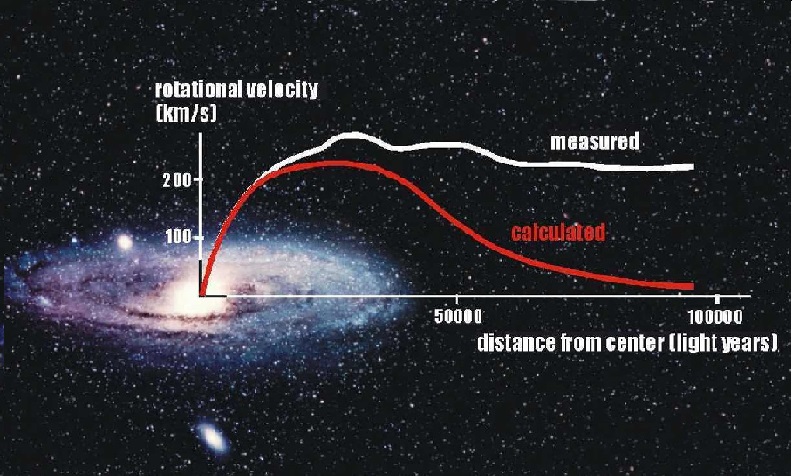
There are different approaches for investigating the force as well as the gravity. Newton emphasized the mathematical meaning of gravity. Einstein’s gravity is geometry. The physical exploring for the gravity is still on the way. Le Sage investigated the nature of gravity, but his theory has many defects. This paper gives out a physical chemistry approach for the nature of force, which bases on gravitons’ reaction by introducing the concepts of Gibbs free energy change and holographic screen. The change of the Gibbs free energy results in the imbalance on the two sides of the holographic screen, it is the force. The change of force as the distance depends on the distribution of gravitons. For solar system, the graviton gas distributes in center-radical pattern, so the inverse-square law is applicable. But in the galaxies, the distribution of the graviton gas is not in center-radical, therefore the acceleration is just inversely proportional to the distance (not square of distance), which is equivalent to the centripetal force. The flatness of rotation curve can be explained without dark matter.
Downloads
References
Bullen, K., & Haddon, R. (1967). Earth models based on compressibility theory. Physics of the Earth and Planetary Interiors, 1(1), 1-13.
Capozziello, S., & Stabile, A. (2009). The Newtonian limit of metric gravity theories with quadratic Lagrangians. Classical and Quantum Gravity, 26(8), 085019.
Carlip, S. (2000). Aberration and the speed of gravity. Physics Letters A, 267(2-3), 81-87.
Edwards, M. R. (2002). Pushing gravity: new perspectives on Le Sage's theory of gravitation: Montreal: Apeiron.
Feynman, R. P., Morinigo, F. B., & Wagner, W. G. (2003). BOOK REVIEW: Feynman Lectures on Gravitation. European Journal of Physics, 24, 330.
Hofmeister, A., & Criss, R. (2017). Implications of Geometry and the Theorem of Gauss on Newtonian Gravitational Systems and a Caveat Regarding Poisson’s Equation. Galaxies, 5(4), 89.
Isaacson, W. (2007). Einstein: His life and universe: Simon & Schuster Audio, New York, USA.
Jammer, M. (1999). Concepts of force: A study in the foundations of dynamics: Courier Corporation.
Lin, C., & Shu, F. H. (1964). On the spiral structure of disk galaxies Selected Papers of CC Lin with Commentary: Vol. 1: Fluid Mechanics Vol. 2: Astrophysics (pp. 561-570): World Scientific.
Luković, V., Cabella, P., & Vittorio, N. (2014). Dark matter in cosmology. International Journal of Modern Physics A, 29(19), 1443001.
Marsh, G. E., & Nissim-Sabat, C. (1999). Comment on “The speed of gravity”. Physics Letters A, 262(2-3), 257-260.
Newton, I., Cohen, I. B., & Whitman, A. (1999). The Principia: Mathematical Principles of Natural Philosophy: University of California Press.
Potcoava, M. C. (2009). Digital holography applications in ophthalmology, biometry, and optical trapping characterization.
Rubin, V. C., & Ford Jr, W. K. (1970). Rotation of the Andromeda nebula from a spectroscopic survey of emission regions. The Astrophysical Journal, 159, 379.
Stabile, A., & Scelza, G. (2011). Rotation curves of galaxies by fourth order gravity. Physical Review D, 84(12), 124023.
Van Flandern, T. (1998). The speed of gravity—what the experiments say. Physics Letters A, 250(1-3), 1-11.
Zwicky, F. (1937). On the Masses of Nebulae and of Clusters of Nebulae. The Astrophysical Journal, 86, 217
Published
Issue
Section
License
Copyright (c) 2019 International Journal of Fundamental Physical Sciences

This work is licensed under a Creative Commons Attribution-NoDerivatives 4.0 International License.


 WorldCat
  Scilit
  ORCID
ORCID  Dimensions
  Mendeley
  Lincoln Library
  Cambridge iDiscover